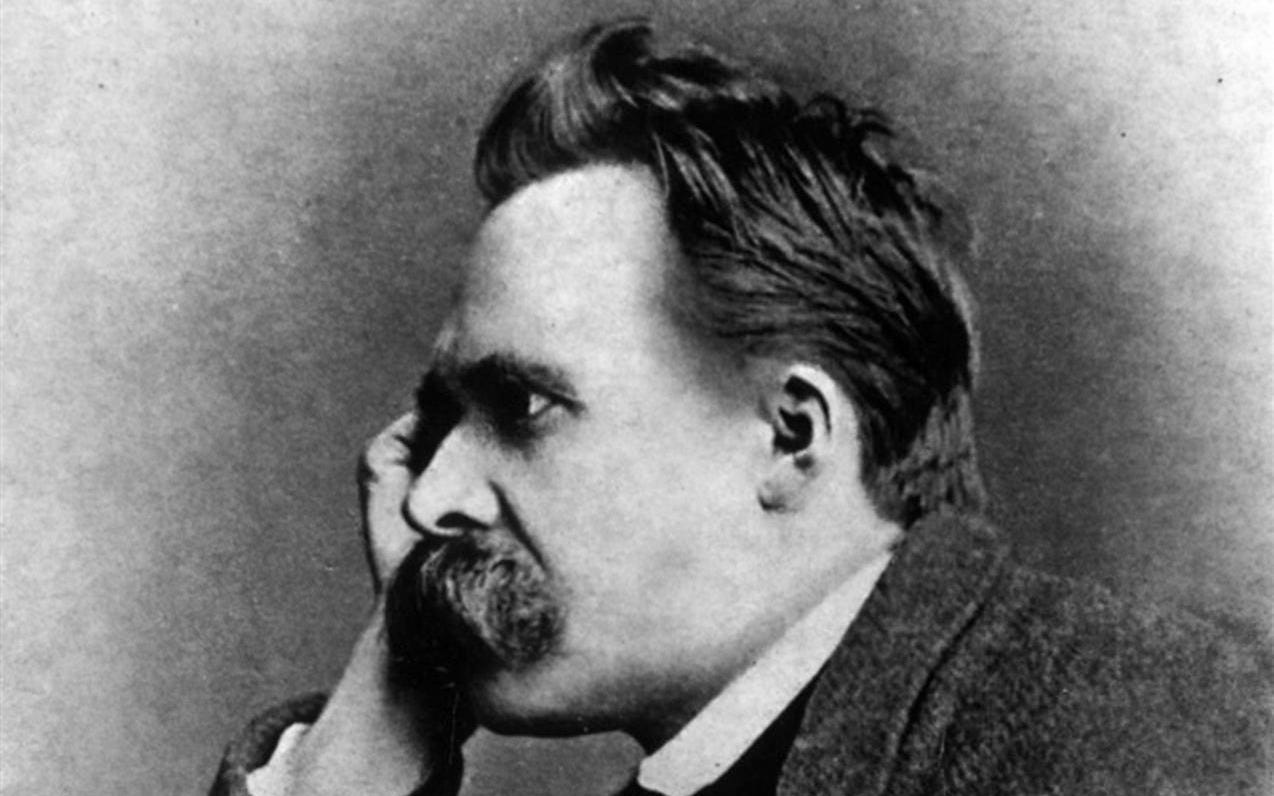
What Did Nietzsche Really Mean?
Piecing Together the Life, Meaning and Legacy of Friedrich Nietzsche
“And so it begins”, my brain whispered a tad overdramatically as I was giving the first pre-recorded interviews on my new book WEIMAR. It’s about a month to the UK and Germany launches on 7 May and another month before the American launch on 9 June. So my schedule is beginning to build up to mildly daunting levels. There is a spreadsheet with my post-launch life on it…
I’ve learnt from my last two books that the trickiest part of these early interviews is finding a way to explain the ideas, events and people in your book in just a few sentences. Journalists, podcasters and readers ask questions like “So what was Otto von Bismarck like?” or “Can you describe the relationship between the GDR and the Soviet Union?” Good questions, but big questions. You have to find a way to answer them succinctly, ignoring the nagging academic’s voice in your head that shouts, “Don’t! It’s a trap! It’s too complex!!”
I’m still finding my feet with that on WEIMAR. This week, I ran into the challenge of explaining the ideas of Friedrich Nietzsche.
As a person, Nietzsche only tangentially features in my book because he died in 1900 and I cover the period between the two World Wars, so 1919-1939, when he was already dead twenty years and more. But the philosopher died in Weimar, where his sister Elisabeth had established an archive of his work and began actively nurturing and shaping his legacy. She is a central figure in my book, and her life cannot be understood without the Nietzsche cult that held much of German intellectual life in its thrall at the time.

So there I was this week, trying to sum up Nietzsche. This is surprisingly difficult, a problem I had already encountered when I tried to give a brief overview of his life and ideas in the book itself. Two major issues present themselves:
One, Nietzsche didn’t and didn’t seek to establish a coherent philosophy. He often wrote in short mini-essays, some of which aren’t even a page long. While this makes it possible to dip in and out of Nietzsche more easily than is the case with many other philosophers whose work depends on you following their logical thought processes systematically, it’s also rather incoherent.
The man also changed his mind throughout his life, as people do, and then simply wrote more things on his new insights rather than building on his existing corpus. So you’ll also find contradictory passages. Topics can be as lofty and theoretical as morality and the meaning of life, or as surprisingly concrete and specific as his thoughts on nature, food and exercise often are.
Two, Nietzsche suffered a nervous breakdown in 1889, which incapacitated him mentally and physically. His sister Elisabeth became his carer and the guardian of his work. As I trace in my book, she also financially depended on selling her brother’s output, and for that, it needed to be brought into a more coherent form.
Take The Will to Power, a core concept in Nietzsche’s work, but one he never really fully and systematically developed. His sister made it saleable by taking one of Friedrich’s twenty-five draft outlines for a book by that title, choosing one that happened to have just four clear chapter headings, and then scouring his notes for material that fitted each section. This copy-and-paste job was then published as The Will to Power under Friedrich Nietzsche’s name as if he’d written it. It became a bestseller, and Elisabeth eventually even gained the copyright for it, ironically by proving that it was not, in essence, her brother’s intellectual work but an edit so drastic that it created a new thing altogether.
During his lifetime, the philosopher had actually considered writing a book with that title himself, but eventually gave up on the idea, reusing the draft title page as a shopping list. So much of what happened with Nietzsche’s ideas later on went through his sister’s filter, a filter that was adjusted and readjusted for both financial and political reasons. For a time, Adolf Hitler visited Elisabeth at the Nietzsche Archive on every single one of his visits to the town of Weimar.

So how can we know what the real Nietzsche thought, let alone summarise it? That was a question I spent an inordinate amount of time on while researching for my book. I was struck not only by how fervently his sister believed that his philosophy had something vital to offer humanity, but also by how many others shared that belief. Those others came from all sorts of different backgrounds. There was the liberal, democratic and at times rather left-leaning diplomat Harry Graf Kessler, who remained a lifelong friend of Elisabeth’s despite their political differences (Elisabeth was a staunchly conservative nationalist). The writer Thomas Mann was fascinated by Nietzsche, as were artists, feminists, Nazis and communists. In the time that I was studying, the period after the First World War, there was an outright Nietzsche cult, fanned artfully by the philosopher’s sister.
Why? That remains a pertinent but difficult question. A good place to start looking for an answer is the man himself. At first glance, there was nothing special about him. He was born in 1844 in a small village called Röcken in central Germany, not far from Leipzig. It was at the time part of the Prussian part of Saxony. His father, a Lutheran pastor, died when Friedrich was just four. Growing up, he soon showed academic brilliance and became a professor of classical philology at the University of Basel at just 24.
However, persistent health problems forced him to resign and spend much of his life travelling and writing independently. This is when he wrote most of the things that would later make him famous. But ironically, he was largely ignored until he went mad and became incapacitated from 1889 to his death in 1900. So most people became fascinated by his work at a time when they could no longer ask him to explain any of it. I think that, along with the fragmented nature of his philosophy, these are some of the ingredients that make his writings so attractive to so many people.
Friedrich's onset of madness coincided with Elisabeth's re-entry into the picture. The siblings had grown up together, with Friedrich jokingly nicknaming his sister “the Llama”, comparing her to a stubborn animal that spat when angered. But then they had gone their separate ways. Bear with me, this is where it gets a little absurd.
Elisabeth married a man called Bernhard Förster. He was a virulently antisemitic school teacher who founded a settlement in Paraguay called “Nueva Germania”, which he intended to be a racially pure settlement where “Aryans” would live (and procreate) without foreign or Jewish influence. Elisabeth had joined him in this endeavour, travelling to the New World in 1886. Three years later, the project had failed, and Bernhard poisoned himself in a hotel room in San Bernardino.
His widow returned to Germany dejected and penniless but found that her brother had become both incapacitated and famous. After Friedrich’s death, she continued to edit and publish his work with considerable social and economic success. Fiercely guarding access to the original writings, Elisabeth had a monopoly on their interpretation. She also preserved Friedrich’s “death room” in the archive in Weimar, where people would be invited to see the site of the famous philosopher’s death. This helped further the cult around his work.
Despite all of this, there are a few clear thoughts that come through the fog surrounding Nietzsche. His philosophy challenged the way people thought about truth, morality and meaning. He believed that many of the values taken for granted, especially ideas of “good” and “evil”, are not universal truths, but human inventions shaped by history, culture and power. Therefore, they can be deconstructed and shrugged off.
In his view, traditional morality (especially Christian morality) often praises weakness, obedience and self-denial, which he thought held people back from fully living. Instead, Nietzsche encouraged individuals to question inherited beliefs and to create their own values based on strength, creativity and life-affirmation (the latter even if and especially when it involved suffering). At the centre is the idea of agency.
His famous phrase “God is dead” needs to be seen in this context. He didn’t mean it literally in the sense that God had existed and then died. Instead, he meant that, in modern society, Christian beliefs were losing their power and credibility due to science, Enlightenment ideas, reason and cultural change. Therefore, he figured, Christianity as a belief system could and should no longer be the central organising principle of Western society.
At the same time, the crumbling of old certainties worried him because he felt it might leave people to feel that life had no meaning. He was urging humans to take responsibility for creating their own values and meaning. This idea was particularly potent after the First World War, when a conflict on that scale seemed to put everything into question but also wipe the slate clean for new opportunities.
Another of his famous ideas is the aforementioned “will to power,” which was never clearly defined but, in essence, seems to suggest that a fundamental human drive is not just survival or happiness but the desire to grow, overcome challenges and assert oneself in the world. Closely tied to this is his concept of the “Übermensch” (or “Super Human”), an ideal individual who rises above conventional morality and creates their own purpose and meaning. Both were later appropriated by the Nazis to give their radical new ideology philosophical roots. Elisabeth’s edited versions of her brother’s words and her later behaviour made this much easier than it might have been based on Friedrich’s published and unpublished work alone.
Especially Elisabeth’s compilation of “The Will to Power” was more accessible than her brother’s notes, creating a Nietzsche image that lent itself to the glorification of violence, might and superiority for people who couldn’t or wouldn’t bother with the originals, to which she had restricted access over many years. Nietzsche became an intellectual and spiritual resource for Nazis to draw ideas and words from selectively. The philosopher himself had been aware of the danger of his work being used for nefarious purposes. He’d once called his concepts “dynamite”.
Suffice it to say that Nietzsche and his philosophy defy neat summarisation. I certainly have a feeling this won’t get any easier the more interviews and talks I give. If you’re interested in Nietzsche but haven’t got the time or the inclination to sift through the vast body of scholarship on him, I can recommend “Nietzsche. A Very Short Introduction” by the late British philosopher Michael Tanner, who wrote about him with clarity and wit. It’s as close to a summary as you’re likely to get.
I will leave you with one of the greatest contradictions between Nietzsche himself and the later appropriation of his work by the Nazis: Nietzsche, while being German himself, was often sharply critical of his compatriots, ascribing moral and intellectual shortcomings to the people themselves and their political projects, including the German nation-state that came into being during his lifetime. “A German is capable of great things,” Nietzsche wrote, “but it is improbable he will do them.”


Coming up with the 5 minute "Cliff's Notes of the Cliff's Notes" of something an author spent many months if not longer on is something that always must be wrestled with when prepping to go out and exhort the masses to contribute to the rent and utility payments. Been There/Done That, it never gets easy.
I attended Michael Tanner’s lectures on Nietzsche when I was an undergraduate and they were excellent. He gave one the impression that much of what passed for academic philosophy was mere parlour games, and that there was more to philosophy- and life itself- than that. He also gave short courses on Schopenhauer and Adorno, as well as philosophical aesthetics, which was his main preoccupation. He was also fascinated by Wagner, and wrote a very good book on him, as well as opera reviews for the Spectator. Early in his career he was in FR Leavis’s circle. He could be entertainingly rude about people he disapproved of. (This was not a short list).