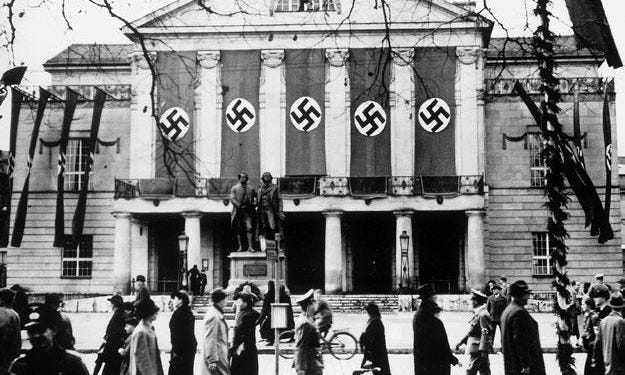
Who was responsible for the catastrophe of Nazism?
Carl Weirich stared at the crematorium ovens. Six gaping holes framed by iron and brick. Their heavy doors stood open, revealing cavities filled with lumpy piles of ash. Something white protruded from the dark mess. Fingers perhaps, or ribs. Carl was nearly sixty years old and had never seen anything so horrifying in his life. He was surrounded by friends and neighbours, but there was no comfort in that. Everyone in the room was alone with their thoughts.
Someone coughed. A couple of women sobbed quietly. They looked incongruous in their brightly coloured spring dresses, shaky hands pressing handkerchiefs to their faces against the stench of death and misery. Some of the men and women kept their eyes fixed on the American soldier. Standing in between the two rows of ovens, he explained in a firm voice that they had been used to burn the bodies of tens of thousands of human beings and that there were more death mills like this one all over Europe. As he spoke, he looked at the ashen faces of the townspeople in front of him to ensure everyone was listening. For years, he said, ordinary Germans like them had lived under the thick black plumes of Nazi crematoria. Each and every one of them had been a bystander to mass murder.
Carl felt sick and lightheaded. He hadn’t eaten anything since the morning when he and more than 1,000 fellow German civilians had been forced to undertake a two-hour march to come to this place. It was 16 April 1945. Four days earlier, US Army units had occupied the town of Weimar in central Germany, where Carl lived. Eight kilometres northwest, they had made a terrible discovery. Amid the beech forests of the Ettersberg hill, lay Buchenwald Concentration Camp. What the Americans had found there was so horrific that they feared people would find it hard to believe. They decided that, on behalf of German civilians everywhere, Weimarers were to be confronted with the horrors that had unfolded in their midst.
Carl Weirich was among the throngs that set off from Weimar train station at ten o’clock in the morning. A book binder by trade, he ran a stationery shop in the heart of the old town. He had been too old to be drafted to fight for Nazi Germany on the front lines, but he was fit enough to undertake the hike up the steep banks. He had done it many times. The Ettersberg hill was a popular destination for Weimarers seeking relaxation. In the summer months, its forests offered shady walks and splendid views over Weimar. In the winter, it was excellent for sledging and skiing.
It felt odd walking the familiar paths out of Weimar and up the hill, surrounded by many friends and neighbours. Even Mayor Erich Kloss was there. It was an unseasonably warm and sunny day. Many Weimarers seemed almost glad to get out of the rubble of their bomb-ravaged town for a while. People talked among themselves as the long column made its way up the Ettersberg. Kloss noted that ‘because the sun was shining, the whole thing felt like a spring day out [...] women and girls engaged in lively chatter, curious and expectant, among the men, too, there were no glum faces.’
That changed when the Weimarers walked through the gates of Buchenwald. The sheer moral depravity of what had taken place here hit them with blunt force. There was evidence of torture. Prisoners explained the ways in which they had been tormented by their captors. Carl and the others saw the gallows where prisoners had been executed, a wooden block over which they had been bent to be flogged, a long pole around which their arms had been bent backwards until joints dislocated and tendons tore.
They saw corpses piled up on carts, their gaunt faces evidence of the suffering endured in the last moments of life. The stench of bodies decomposing in the spring sun was so strong that some of the women fainted. Teenager Edelgard Schlegelmilch hesitated when she was told to step over a corpse. She just couldn’t bear it any longer. She froze and shut her eyes. An American soldier ordered her to open them. After all, that’s what they had been brought here to do: open their eyes to Nazi crimes. Edelgard did as she was told, walking through the dystopian scenes as if in a trance. ‘This can’t be true,’ she thought. ‘You must be dreaming.’
Weimarers insisted again and again that they hadn’t known, that they had no idea such things had taken place, let alone a mere walk away from the beds in which they slept. The US Army filmed the townspeople the day they were confronted with Buchenwald. The resulting documentary called Death Mills or Die Todesmuehlen put the blame for Nazi atrocities squarely on the shoulders of ordinary Germans like Carl. ‘These Germans, the ones who said they didn’t know, were responsible too,’ the narration insists. ‘They had put themselves gladly into the hands of criminals and lunatics. They tell you now they meant no evil, that they knew nothing of what was going on or could do nothing even if they knew. [...] Today, these Germans who cheered the destruction of humanity in their own land, who cheered the attack on helpless neighbours, who cheered the enslavement of Europe, plead for your sympathy.’
To Carl, visiting Buchenwald felt like ‘running the gauntlet.’ He wrote that ‘it took strong nerves to see the terrible things in the crematorium and also in the barracks, where a number of sick prisoners still lived.’ He may not have admitted this to the Americans, but he confided in his diary that what he witnessed up on the Ettersberg had been ‘atrocious crimes committed by us.’ His heart had filled with disgust and shame about ‘our German downfall.’ There was no getting away from it. Not far from his home, tens of thousands of people had been murdered by a regime cheered on by millions of Germans. Carl had been no exception.
Like many Germans of his generation, Carl did not spend much time pondering his own responsibility for what had happened. He focused his mind on the immediate threats to himself and his family, on grief, trauma, hunger and destruction. It would fall to later generations to draw conclusions from one of the darkest chapters in human history and to decide what to learn from it.
The question of how and why a nation that prided itself on its culture and civility enabled the catastrophe of Nazism haunts us to this day because we fear a repeat. It is no mere historical question. ‘It happened, therefore it can happen again,’ warned Holocaust survivor Primo Levi. Despite the many pages written on the rise of the Third Reich, the matter is worth re-examining at the granular level. How did Germany, within a few years, turn from one of the most liberal democracies in the world to a genocidal dictatorship? What choices did individual Germans make that enabled this? A crucial piece of this 20th-century puzzle is the town of Weimar.
Weimar lies in the heart of Germany. On a map of the country, it sits slightly off-centre, about halfway between Hamburg and Munich. It is a quaint town, conscious of history and tradition, both of which it has in abundance. Its cobbled streets are home to timber-framed houses, elegant villas, churches, palaces and deep green treetops. Situated in the valley of the River Ilm, its leafy parks are so expansive that one 19th-century writer joked that ‘Weimar is really a park that has a town.’ Weimar has attracted many famous residents. Johann Wolfgang von Goethe, widely regarded as Germany’s national poet, lived and worked here with his friend and fellow writer Friedrich Schiller. Johann Sebastian Bach resided in Weimar for years, as did fellow composer Franz Liszt and the philosopher Friedrich Nietzsche. Weimar’s place in German cultural history far exceeds its physical size.
‘Weimar is Germany in a nutshell,’ the former German President Roman Herzog once said, ‘a town in which not only culture and thought were at home but also philistinism and barbarism.’ Weimar has long been Germany’s beacon of culture, but for a time, it was also its heart of darkness. It represents all the country gained, lost, suffered and inflicted. At no time was this more true than during the tumultuous period between the two world wars, from 1919 to 1939.
This was an abstract from my brand new book Weimar: Life on the Edge of Catastrophe which is out today in the UK, Germany and the Netherlands. The reviews so far have been encouraging. I hope readers, too, will find it interesting and thought-provoking material for our times.
Reviews
“Weimar is populated not by abstractions but by people... Hoyer writes with verve and a keen eye for telling detail... She shows with quiet acuity how ordinary, self-respecting Weimarers succumbed to the siren call of Nazism” – The Times
“Superb... Katja Hoyer finds the town of Weimar a perfect microcosm for a country teetering into darkness... intelligent, original and well-researched... an exemplary insight into a grim chapter in German history” – The Telegraph
“Such an important book” – The Independent where Weimar is Non-Fiction Book of the Month
“Humane history-writing at its best, even when it focuses on inhumanity” – Literary Review
“Its writing is gripping, Hoyer’s command of existent histories is clear, and her primary research is thorough and inventive... Reading Hoyer’s book, I recalled Svetlana Alexievich’s stated aim in Voices from Chernobyl: to tell the stories of ‘little, great people’ who voice their ‘own, little histories’ while ‘big history is told along the way’. This is where Weimar: Life on the Edge of Catastrophe excels” – History Today
“”Eine packende Zeitreise, die mit Schwung in der Gegenwart endet.” – Der Falter
“Katja Hoyer hat sich als präzise Chronistin deutscher Geschichte profiliert. Mit Weimar legt sie nun eine ebenso eindringliche wie beunruhigende Analyse vor.” – Berliner Morgenpost


Excellent writing — I’m really looking forward to the book. Of course, the short answer to the question of who was responsible is, the voters, who freely gave the National Socialists a plurality of seats in the March 1933 election that, combined with the deal with the supine Centre party, which traded its support for a worthless concordat with the Vatican, produced a majority in the Reichstag, even if the Communist deputies had not been driven away. It all starts with the German people, IMO …
Two copies came yesterday. One half consumed already, the other for a friend's (belated) birthday present on Saturday. Stanford Prison/Das Experiment, Lord of the Flies, Animal Farm, etc coming back to memory. The gossamer-thin veil between enlightenment and barbarism, good and evil. The crux when they are held simultaneously consciously (by leaders) and unconsciously (by the rest of us). As a small child, reading a graphic, pictorial history of The War in six volumes, fascinated until the volume for 1945, then disgusted to my heart's root. My late father never talking about his reasons for leaving his mother in Danzig, never to return to her or Gdańsk before the Wall came down. Never needing to. The whole story in those words and pictures.
I do hope "Weimar" reaches far beyond its core audience, lest we (try to) forget our legacy, and (try to) ignore our responsibility to the present and the future.