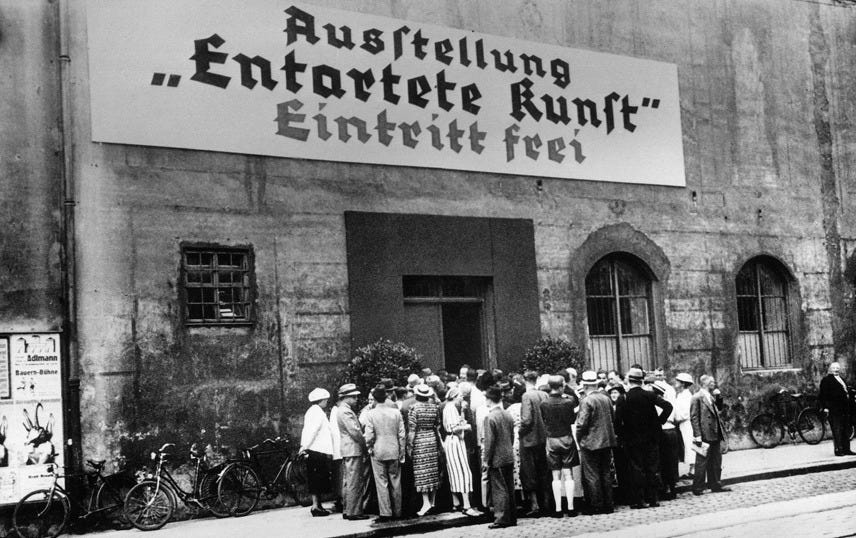
Why did so many people want to see "Degenerate Art" in 1937?
Or: The Worst Exhibition in the World

On 23 March 1939, there was a flurry of excitement in the picturesque town of Weimar. A famous art exhibition was in town. Called Degenerate Art (Entartete Kunst), it had been launched in Munich nearly two years earlier and then toured Germany and Austria. Not to be outdone, Weimar pushed to be included on the exhibition tour. Following stints in Berlin, Leipzig, Düsseldorf, Salzburg, Hamburg and Stettin, it finally opened its gates to visitors at the State Museum in Weimar.
Local Nazi culture functionary Hans Severus Ziegler, whose initiative had brought the exhibition to town, was extremely pleased. Speaking at the opening, he expressed his hope that the show would “expose the mistakes of the past as clearly as possible”. Then he released the guests to roam around the twenty rooms of the exhibition.
What they saw was a collection of pieces of art that they wouldn’t get to see anywhere else. The Nazi regime had removed them from galleries and museums because they deemed them “degenerate” — too modern, too abstract, too critical, too socialist, too Jewish. Weimar’s state collections alone had lost 450 items.
The Nazis were hoping that by viewing some of the 21,000 items they had seized, people would “gain harrowing impressions of Jewish cultural Bolshevism,” and leave “the exhibition with a feeling of gratitude towards the Führer, who had had these products of madness removed from the museums.” In an effort to give the impression of moral depravity, the authorities banned anyone under the age of eighteen from visiting.
According to the Nazified press, the Weimar showing was a resounding success, with some 6,000 people visiting the State Museum in the first week alone. It’s impossible to know who attended and why. But that’s a fascinating question nevertheless. Had people indeed come to jeer and laugh at the art on display? Or was it possible that some Weimarers may have regarded it as their last chance to see works of art that had otherwise vanished from view?
What made Degenerate Art one of the most visited exhibitions of its time is one of the many intriguing questions at the heart of art historian John-Paul Stonard’s new publication, The Worst Exhibition in the World. In just 128 pages, this concise, well-written and beautifully illustrated book takes you right into the exhibition itself — a guided tour of the crowded vaults of the Hofgarten arcade, revealing one of the most bizarre cultural shows of the 20th century.
When I recently had the great pleasure of being on the BBC’s Start the Week with John-Paul Stonard, I couldn’t help myself and asked him if he’d be willing to provide us here on ZEITGEIST with a sneak peek into his brilliant book. I’m thrilled that he has agreed and that I can share the following extract with you. Enjoy!
The Worst Exhibition in the World: Degenerate Art, 1937
By John-Paul Stonard
Extract
When the exhibition of Entartete Kunst or ‘Degenerate Art’ opened in the Hofgarten arcade in Munich in the summer months of 1937, visitors were met with nine narrow galleries crammed with works of art which, only a few weeks earlier, had been on display in some of the most prestigious museums in Germany.
On museum walls they had been held as some of the greatest achievements of the modern movement in art. Hung in cramped galleries in the Hofgarten arcade, they were pilloried as the work of the insane, the criminal, the Jewish, the Bolshevist, the un-German ‘degenerate’.
The purpose of the Nazi exhibition was clear. Neatly lettered labels and inscriptions expressed Adolf Hitler’s fury at the distortions of modern forms of art. Quotations from art historians, artists and their supporters covered the walls, including comments by the many museum directors who had bought these paintings and sculptures for public collections. Alongside were pasted the allegedly ridiculous amounts paid for certain works of art – but not the fact that many of these prices were paid during the hyperinflation of the early 1920s.
It was the first time that such a remarkable range of modern German painting and sculpture had been shown together. Paintings from the great surge in creativity before 1914 hung alongside the world of images that arose during the Weimar Republic, after the national trauma of defeat in 1918 and humiliation at Versailles. It was, quite ironically, the first and last great exhibition of modern German art in Europe before the Second World War, showcasing all its many styles and directions, including Expressionism, Cubism, Dada, Surrealism, Bauhaus and the distinctive work of artists such as Max Beckmann, Otto Dix and Oskar Schlemmer.

The speed with which such a large quantity of art was transformed into propaganda is astonishing. Barely three weeks before the opening on 19 July, a committee headed by Adolf Ziegler, president of the Reichskulturkammer or Nazi ‘Chamber of Culture’ and himself a painter of classical nudes, was formed to seize modern art from public collections. Museums across the country were scoured. Over seven hundred works were confiscated and brought to Munich and then hastily arranged in a set of galleries that had been just as swiftly cleared of plaster casts of antique sculptures belonging to the Institute of Archaeology.
If you ignored the wall texts and the close hanging, Entartete Kunst could be experienced as an all-round introduction to contemporary German art, containing some of the cornerstone works of the modern movement. In the first room, Emil Nolde’s monumental Das Leben Christi (‘The Life of Christ’) and a ghostly painting of the Descent from the Cross by Max Beckmann set the tone for the sheer quality of works to come. Almost every German artist of note of the past thirty years was included, as were major works such as Otto Dix’s The Trench, a grisly indictment of war, and Franz Marc’s The Tower of Blue Horses. Both paintings were lost after the exhibition, possibly destroyed – this was their final public showing.

The Hofgarten arcade was also the setting for the first historic display in Germany devoted to the ‘anti-art’ of Dadaism, with collages by Kurt Schwitters and archival material in the form of journals with designs by Raoul Hausmann. As a movement devoted to reshaping consciousness through recreating language, Dada was in many senses a forerunner of National Socialist propaganda, if devoted to entirely different aims. There were also many works by artists of the Bauhaus school of art. Membership of either group automatically assured ‘degenerate’ status, which was otherwise only ever defined in very vague and entirely negative terms.
These great and powerful works hung in an enfilade of seven galleries running along the first floor of the Hofgarten arcade. On the ground floor, two barrel-vaulted rooms were filled in a more haphazard manner, with works of art arranged in glass cases that ran the length of both walls. Here could be seen famous print portfolios including Der Krieg (‘War’) by Otto Dix, arguably the most important set of prints published during the twentieth century, and Wassily Kandinsky’s historic woodcuts, titled Klänge (‘Sounds’), which might be taken as illustrations of his great theory of abstract painting, Über das Geistige in der Kunst (‘Concerning the Spiritual in Art’), published in 1911. Alongside were ranged journals and books that had played a role in disseminating new ideas about art in the first three decades of the twentieth century.

Despite the extremely hasty organisation, poor lighting and close hanging, the few surviving photographs show that the paintings and sculpture were displayed not chaotically, as is so often claimed, but in a considered, sometimes even well-curated manner. It was clearly an exhibition designed to prove a grim point, but at almost every turn the works of art had the opportunity to contest their fate. It was not difficult to read the paintings against the intentions of the organisers: not as an indictment of their creators, but as the revelation of a new world of art. In hindsight, at least, Entartete Kunst appears as a highly charged arena, a crucible of the war over different forms of modern art that raged throughout the twentieth century.

An astonishing number of people saw Entartete Kunst. Even its chief architect Joseph Goebbels, who only jotted down the idea in his diary the previous year, must have been surprised and perhaps perturbed by its success. It was supposed to run for two months, but was extended to four. On some days more than twenty thousand people are said to have passed through the galleries. On Sunday 1 August, reported the Birmingham Evening Despatch, 35,600 people passed through the narrow rooms of the Hofgarten arcade.1 The sheer number of visitors suggests that many visits were quick and tokenistic, part of a ritual of allegiance to the Reich. Large groups were brought in by bus and train and herded through the galleries. And yet there is ample evidence that many visitors encountered the works in a spirit of surprise and admiration, and that where many came to laugh and jeer, others came to say goodbye.
By the time the exhibition closed it had been visited – at least according to official figures – by around two million people. Such was its success that it was sent on a tour of German and Austrian towns and cities and over the next three years was seen by a million more people. Even taking into account the likely inflation of visitor numbers, Entartete Kunst remains one of the most visited exhibitions of art ever mounted, either at the time or since.
John-Paul Stonard’s The Worst Exhibition in the World is out now, available in bookshops and online.
You can listen to our discussion on the BBC’s Start the Week programme on Sounds here.
John-Paul also has a weekly Substack called ON ART, which you can read here.


Most interesting i did wonder what happened to the art pieces after the exhibition had finished, so I listened to the Sounds clip which was very informative, I've reached 1929 in the excellent Weimar, 5000 pieces destroyed, so I expect some survived the nazi era but many did not or just disappeared.