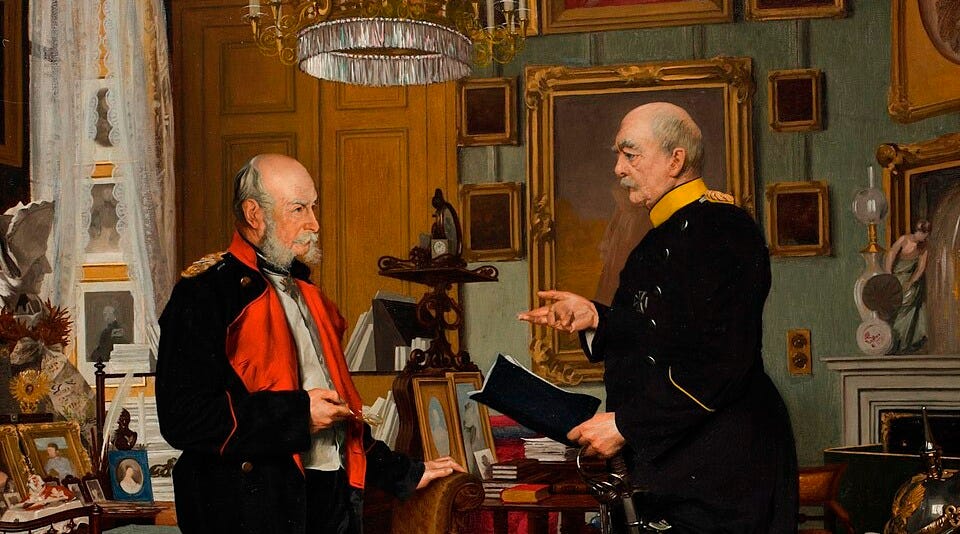
Wilhelm vs Bismarck: Who really unified Germany?
Or: Kaiser Wilhelm I. as you've never seen him before
When I tell people I’m a historian, one type of response I get every now and then is: “What do historians actually do these days? Surely, there can’t be anything left to say? They have already found out what happened in the past. So, unless you dig a hole in the desert and find the remains of a pharaoh nobody knew about, how can you write new books?”
There are many retorts to this. One came this week in the form of an interview about a (relatively) new book which aims to turn an entire field of scholarship on its head. The German historian Jan Markert didn’t dig a hole in the ground, but he dug around in the archives and unearthed a wealth of new findings about Wilhelm I, King of Prussia and the first Kaiser of the German Empire.
Generations of historians (myself included) have told the story of German unification like this: Otto von Bismarck, the man who would go down in the annals as the “Iron Chancellor”, cunningly engineered the creation of the first German nation state in 1871.
Bismarck was not a German nationalist but rather saw an opportunity to extend Prussian power into other German-speaking territories by creating a unified country that excluded Austria and was run with the Prussian King as the German Kaiser at the helm. In this traditional account, the Kaiser, that is Wilhelm I., appears as a rather passive figure, dignified, conservative, but ultimately politically dependent on his formidable Prime Minister, Otto von Bismarck.
Jan Markert’s biography of Wilhelm I. seeks to overturn that familiar picture. Drawing on extensive archival research (9000 letters alone!), Markert argues that Wilhelm was not a passive figurehead who had to be dragged kicking and screaming to his throne at the top of the new reich, but a decisive political actor in his own right who played a crucial role in creating and shaping the German Empire.

At the centre of Markert’s argument is a reassessment of the relationship between Wilhelm and Bismarck. Rather than portraying Bismarck as the dominant strategist, Markert suggests it was the other way around. In the interview this week, the historian went as far as to say that Bismarck “basically sucked up to” Wilhelm (the German expression is “to climb up somebody’s backside”).
Markert posits that Bismarck intensively lobbied the future king for years before his appointment as Prussian Prime Minister in 1862, promoting himself through intermediaries and memoranda while aligning closely with Wilhelm’s goals.
Once in office, Markert argues, Bismarck soon discovered that his freedom to manoeuvre was limited because Wilhelm, far from being politically naive, enforced clear boundaries and kept the bullish Bismarck in check. Ministers who deviated from his preferred course could be dismissed, and even Bismarck had to adapt to the monarch’s priorities to remain in power. In this interpretation, the Prime Minister’s authority depended on his willingness to follow the king’s lead rather than vice versa.
One of Markert’s most striking claims concerns the course and causes of German unification itself. He contends that Wilhelm had been pursuing an aggressive and purposeful agenda towards this goal long before the wars of the 1860s and early 1870s. In fact, he traces this back to the 1848/49 revolutions, which had been a formative and traumatic experience for Wilhelm. Uprisings and street barricades in Prussia had come close to threatening the monarchy itself, and from this, he developed ideas to strengthen monarchical authority while advancing a Prussian-led project towards a German nation-state.
This perspective challenges the established view that Bismarck devised the strategy behind the three wars that led to unification (Denmark 1864, Austria 1866 and France 1870/71). Markert argues that Wilhelm was not reluctantly pushed into accepting that these conflicts were necessary but instead recognised and exploited the opportunities they brought to expand Prussian power.
Why, then, one might ask, has this more active image of Wilhelm I not dominated historical writing before? Markert has a plausible answer to this. He attributes the persistent image of Bismarck and Wilhelm to the nature of the sources historians have traditionally relied upon.
Much of the established narrative, he suggests, is based on Bismarck’s own memoirs and retrospective accounts, which naturally emphasise his own role. By contrast, Wilhelm left behind an enormous but underused body of material: tens of thousands of pages of correspondence and documents.
It is certainly true that Bismarck was extremely conscious of his public image and cultivated it at every opportunity, from accepting life-or-death duels with political opponents to being a brash, sometimes outright outrageous orator. I draw on such anecdotes frequently in my own book, Blood and Iron, because they create vivid images of Bismarck and captivate people as much now as they did at the time.
Markert says Wilhelm’s much more boring and overwhelmingly voluminous records are much harder to comb through and much less engaging. He has had to examine thousands of letters and diary entries, many of which had never been fully published or systematically analysed. Within them, he identifies repeated expressions of Wilhelm’s political views and long-term aims.
This archival work forms the basis of his claim that earlier historians overlooked crucial evidence because of the sheer scale, difficulty and tedium of the material. Bismarck also outlived Wilhelm by a decade (Wilhelm died in 1888, and Bismarck in 1898), giving the chancellor more time than the Kaiser to shape the record of their power dynamics.
Another key aspect of the reinterpretation concerns the period after the founding of the German Empire in 1871. While it is widely accepted that Bismarck exercised considerable autonomy as imperial chancellor, Markert argues that Wilhelm retained ultimate authority over major decisions. The relationship, in his view, functioned as a “decision-making duo,” but one in which the emperor always had the final say and could impose limits on his chancellor’s actions, not least because his constitutional role as head of state allowed him to sack and appoint chancellors.
Whether this reinterpretation will gain wide acceptance remains to be seen. It certainly challenges deeply entrenched assumptions about one of the most studied periods in modern European history, and that’s no mean feat.
By foregrounding neglected sources, putting in the work to find and analyse vast amounts of primary source material from scratch and revisiting familiar events from a different perspective, Markert’s work invites readers to reconsider how the German Empire came about and who, ultimately, was responsible for shaping it.
Instinctively, I can see that Wilhelm is a much more strong-willed man than he is often given credit for. In the 1848 period, he acquired a bit of a reputation for being quite despotic since he pushed for a violent repression of the workers’ uprisings while his brother (Frederick Wilhelm IV), who was actually in charge as King, dithered. It’s also no secret that he often clashed with Bismarck and that the two argued over policy matters.
Ultimately, the answer is probably (as ever) more complex than to say one man dominated the other. Bismarck found out when he clashed with Wilhelm’s grandson, Wilhelm II, that he couldn’t run the country without a Kaiser willing to grant him the freedom to act. But Wilhelm I also didn’t possess the diplomatic and political guile and skill of a Bismarck – or else why keep such a brash and domineering figure at the helm? That is ultimately what brought Bismarck down after Wilhelm’s death in 1888: conflict with the monarch. Bismarck and Wilhelm I. needed one another, and, on the whole, they shared the same aim: extending Prussia's power while preserving the old order as much as possible. It’s hard to disentangle which impetus came from whom.
Markert’s research and bold new thesis certainly show that you don’t have to dig up an unknown pharaoh to write new and meaningful history.
You can find the interview in full here and Jan Markert’s work here.
PS: Our new German History podcast, Reichs and Republics, this week is about the brutal Turnip Winter of 1916/17. Tune in on any platform and leave us a review if you liked it.


Sounds like important work by Jan Markert, it can't of been easy trawling thru all those archives,just reading the handwriting would be a task in it's self .I wonder if Bismarck died first by ten years if Germany would covered by Wilhelm statues .Enjoying the educational podcast by the way top stuff.