Should 8 May be a public holiday in Germany?
VE Day, Liberation Day or no special day?
“Isn’t it strange how many Germans still refer to the ‘former’ GDR?” asked the historian Richard J. Evans as we sat in the green room at Dulwich Literary Festival yesterday, sipping sparkling water and waiting to go on stage to discuss my WEIMAR book. “After all, nobody refers to the ‘former’ Roman Empire as if it needed clarifying that it’s most definitely no longer here.”
I chuckled. It was a casual remark, but one that put the finger on the many complexities and anxieties of German memory culture.
Shortly after, we walked on stage and chatted for an hour about Germany’s and Weimar’s journey from democracy to dictatorship, from war to war. It didn’t take long before the next issue of memory came up. Richard wanted to know how the history of the rise and fall of Hitler’s regime is remembered in the town of Weimar itself today.
My honest answer was that I have a feeling there is still a lot of renegotiation going on. For a long time, for instance, there was a clear black-and-white picture of the relationship between the modernist Bauhaus movement of art and architecture, which started life in Weimar, and the Nazi regime. While the former was seen as good and eventually victimised, the latter was bad and became the perpetrator.
More recently (in 2024), a major exhibition in Weimar challenged that view, and I used some of that new research to inform the relevant sections of my book. Around a quarter of the Bauhaus artists indeed fled abroad once the Nazis came into power, which inadvertently helped their ideas become one of the most influential cultural movements of the twentieth century. But Hitler wasn’t entirely averse to its modernism and made use of many of the movement’s non-Jewish artists and architects willing to collaborate. While at least 24 Bauhaus proponents were murdered by the regime, there were also 188 who became members of the Nazi Party.
The exhibition of the complex relationship between the Bauhaus and Nazism spanned three parts and was geographically spread across the town. The British writer William Cook, who visited it and wrote a piece on it for The Spectator at the time, opened his article by saying that “a brave group of curators and academics are challenging one of Germany’s most sacred taboos… exposing the hitherto unexplored connections between the Bauhaus and the Third Reich.”
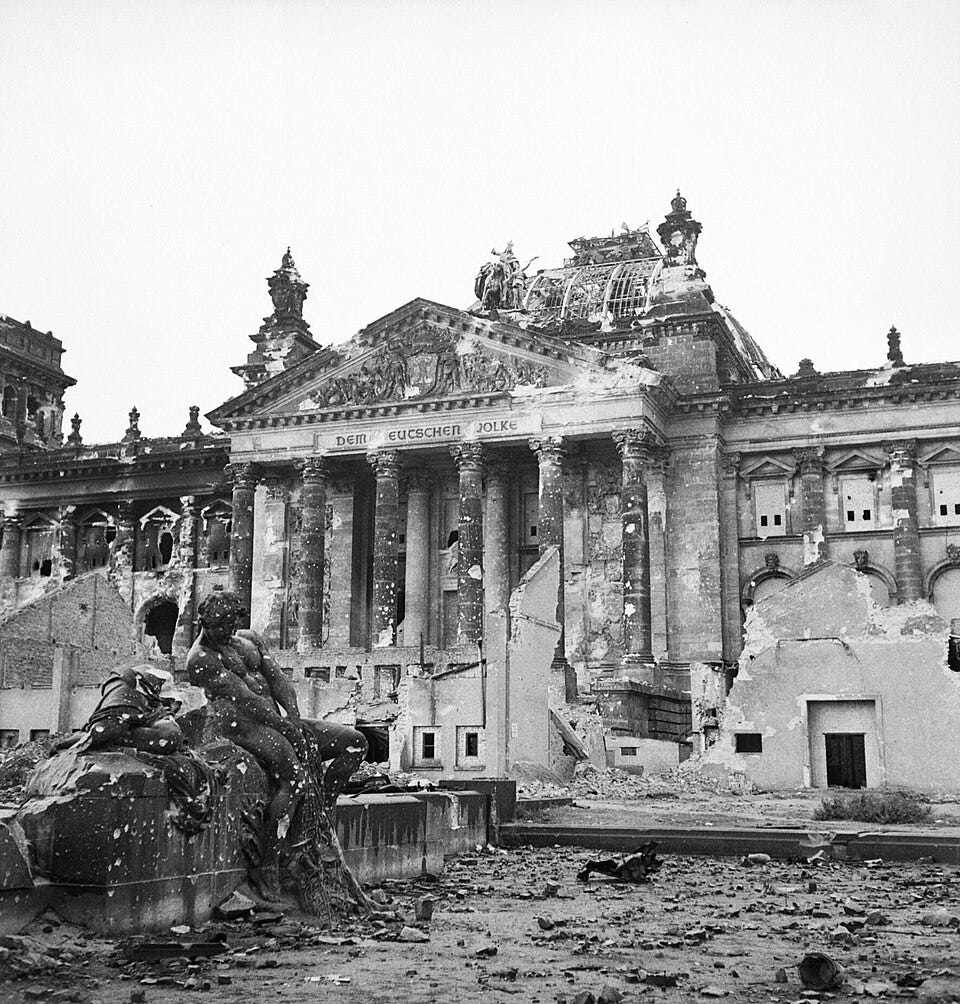
This week, a more fundamental debate took place about the way Nazism should be remembered, or rather, how its demise should be remembered. In other words, how should Germany mark 8 May, Victory in Europe Day? Should it be a public holiday, and if so, what should it be about exactly?
VE Day has long been an awkward day for Germans. At the time, that is in 1945, the majority of Germans who had not been victims of the Nazi regime were glad that the war was over, but they nonetheless regarded this moment as a defeat. In fact, a lot of them didn’t seem to have marked it at all because the end of the war came at different times and in different guises for them.
Take Weimar, which was occupied by US troops on 12 April. By the time that 8 May came around, its residents had already lived under American rule for nearly a month. They had seen curfews imposed, seen liberated prisoners from the nearby concentration camp of Buchenwald roam the streets in search of food and vengeance and been taken up to the camp themselves to witness its horrors.
Young male Weimarers in uniform had been arrested and taken to POW camps. Women and older men had been seconded to work details, including helping to clear up the Buchenwald camp. Defeat and/or liberation was already a fact of life that was simply made formal when the official surrender came. On 9 May, the Weimar bookbinder Carl Weirich, the central “character” of my book, simply wrote in his diary: “Armistice completed between the Allies a. Germany after the demise of the Nazi Party and the death of Goebbels, vanishing of Hitler, Goering, Himmler, Schirach, etc.”
It was a chaotic time, and Germans felt many conflicting emotions. Liberation from Nazism is unlikely to have topped the list for the majority. For that reason, the historian Magnus Brechtken argued in the German press this week that 8 May should not be a public holiday in Germany. “In the self-perception of the vast majority of Germans,” he told the political magazine Der Spiegel, “that date represented a defeat and the end of the way of life they knew. We shouldn’t pretend that most Germans experienced it as a liberation. We should be honest: they didn’t.”
Fellow historian Hedwig Richter disagreed in the same interview, arguing to make 8 May a public holiday not just for Germany but across Europe and calling it “Day of the Liberation of Europe from National Socialism.” She wouldn’t want it understood as a “heroes’ day” but as a “critical national holiday, a day of transformation.”
Personally, I’d be very sceptical of the idea because the end of the Second World War meant very different things for different nations, never mind for individual groups and people within those nations. The victorious nations were, well, victorious. That’s why they have VE Day rather than Liberation Day, and you’d find it very hard to convince, say, a Brit otherwise.
Other European countries ended up behind the Iron Curtain and were occupied by the Red Army following the Nazi occupation. Last year, I attended and wrote about a conference in Prague at which historians from various Eastern European nations debated how the end of the war is best remembered: Was 1945 a moment of “liberation” or further “occupation”? It would seem very odd indeed for the answer to be suggested to them by a German initiative.
Last but by no means least, even within Germany itself, there is a divided memory and a divided experience of 1945 due to the fact that the Soviet occupation of the East was much more brutal than that of the Western powers in the Western zones. What followed was a divided nation with divided memory politics. The East emphasised the idea of Soviet liberation, while the West held on to the idea of defeat for a long time before uneasily shifting to the concept of liberation, notably when then-President Richard von Weizsäcker used the term in his speech on the occasion of VE Day in 1985 (when it was still controversial to do so).
It seems odd to me to attempt to unify the European memory of an experience that was so different in so many countries. For Germany, there is no getting away from the fact that it played a unique and devastating role in causing the conflict that ended on 8 May and that people from other nations stood up against the tyranny its regime tried to unleash all over Europe. It will always have to find its own unique way to mark and remember this history. That alone would make it an odd choice, in my view, as a public holiday.
But do I think it’s right that Germany keeps debating and diversifying the way it makes sense of its own past? Natürlich. I’d be a poor historian in more than one sense if I didn’t.
***
PS: I’d like to inform my British ZEITGEISTERS that WEIMAR will run as Book of the Week on Radio 4 from Monday. Every day, an abridged part of my book will be read by the actress Sian Thomas. You can listen live at 11.45am or stream on catch-up afterwards.


Oh, a difficult one Katja. I think the key facet, as you highlight, is the range of experiences. Even for us on our island it must have been a day of conflicted emotions. Celebrating the end of the war in Europe, yet mourning for the deaths and coming to terms with the physically and mentally wounded. And of course the war in the Far East was still raging. On the European continent the liberated Western European nations had got on with the business of recovering from occupation; celebrating, rebuilding, and let’s not forget meting out retribution to those who collaborated. In Eastern Europe one occupier was replaced by another, perhaps not as organisationally brutal. And having fought the Nazis was no guarantee of a welcome in Soviet occupied Eastern Europe. Liberated Jews discovered there was no welcome for them in much of old Eastern Europe. And then there is the DPs. Perhaps Germany should celebrate the progress made since Stunde Null, acknowledging the division but highlight the growth. But, hey what do I know?
My humble opinion is to leave it as a solemn day and a reminder of what fascism can become when one follows a delusional leader. In Russia it has been a national holiday for 80 years. Putin has taken this and used it as a warped excuse of his barbaric war against Ukraine.